Hanxiu ‘Hazel’ Zhu, Avanthika Senthil Kumar, Sihang Zhao, Ru Wang, Xin Tong, Yuhang Zhao
ACM DL | Direct Download PDF
Publication accepted to ASSETS 2025 and presented in Denver, Colorado, USA
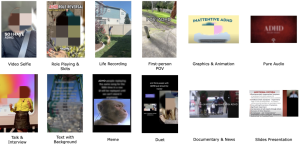
We systematically collected 373 ADHD-relevant videos with comments from YouTube and TikTok and analyzed the data with a mixed method. Our study identified the characteristics of ADHD-relevant videos on VSPs (e.g., creator types, video presentation forms, quality issues) and revealed the collective efforts of creators and viewers in video quality control, such as authority building, collective quality checking, and accessibility improvement.
Publication accepted to ASSETS 2025 and presented in Denver, Colorado, USA
We designed FocusView, a video customization interface that allows viewers with ADHD to customize informational videos from different aspects.
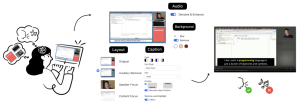
While videos have become increasingly prevalent in delivering information across different educational and professional contexts, individuals with ADHD often face attention challenges when watching informational videos due to the dynamic, multimodal, yet potentially distracting video elements. To understand and address this critical challenge, we designed FocusView, a video customization interface that allows viewers with ADHD to customize informational videos from different aspects. We evaluated FocusView with 12 participants with ADHD and found that FocusView significantly improved the viewability of videos by reducing distractions. Through the study, we uncovered participants’ diverse perceptions of video distractions (e.g., background music as a distraction vs. stimulation boost) and their customization preferences, highlighting unique ADHD-relevant needs in designing video customization interfaces (e.g., reducing the number of options to avoid distraction caused by customization itself). We further derived design considerations for future video customization systems for the ADHD community.
Publication accepted to ASSETS 2025 and presented in Denver, Colorado, USA
We present VRSight, an end-to-end system that recognizes VR scenes post hoc through a set of AI models (e.g., object detection, depth estimation, LLM-based atmosphere interpretation) and generates tone-based, spatial audio feedback, empowering blind users to interact in VR without developer intervention.
Virtual Reality (VR) is inaccessible to blind people. While research has investigated many techniques to enhance VR accessibility, they require additional developer effort to integrate. As such, most mainstream VR apps remain inaccessible as the industry de-prioritizes accessibility. We present VRSight, an end-to-end system that recognizes VR scenes post hoc through a set of AI models (e.g., object detection, depth estimation, LLM-based atmosphere interpretation) and generates tone-based, spatial audio feedback, empowering blind users to interact in VR without developer intervention. To enable virtual element detection, we further contribute DISCOVR, a VR dataset consisting of 30 virtual object classes from 17 social VR apps, substituting real-world datasets that remain not applicable to VR contexts. Nine participants used VRSight to explore an off-the-shelf VR app (Rec Room), demonstrating its effectiveness in facilitating social tasks like avatar awareness and available seat identification.
Publication accepted to UIST 2025 and presented in Busan, Korea.
We present CookAR, a head-mounted AR system with real-time object affordance augmentations to support safe and efficient interactions with kitchen tools. To design and implement CookAR, we collected and annotated the first egocentric dataset of kitchen tool affordances, fine-tuned an affordance segmentation model, and developed an AR system with a stereo camera to generate visual augmentations.
Abstract: Cooking is a central activity of daily living, supporting independence as well as mental and physical health. However, prior work has highlighted key barriers for people with low vision (LV) to cook, particularly around safely interacting with tools, such as sharp knives or hot pans. Drawing on recent advancements in computer vision (CV), we present CookAR, a head-mounted AR system with real-time object affordance augmentations to support safe and efficient interactions with kitchen tools. To design and implement CookAR, we collected and annotated the first egocentric dataset of kitchen tool affordances, fine-tuned an affordance segmentation model, and developed an AR system with a stereo camera to generate visual augmentations. To validate CookAR, we conducted a technical evaluation of our fine-tuned model as well as a qualitative lab study with 10 LV participants for suitable augmentation design. Our technical evaluation demonstrates that our model outperforms the baseline on our tool affordance dataset, while our user study indicates a preference for affordance augmentations over the traditional whole object augmentations.
We designed VRBubble, an audio-based VR technique that provides surrounding avatar information based on social distances. Based on Hall’s proxemic theory, VRBubble divides the social space with three Bubbles—Intimate, Conversation, and Social Bubble—generating spatial audio feedback to distinguish avatars in different bubbles and provide suitable avatar information (Ji, Cochran, and Zhao 2022).
Social Virtual Reality (VR) is growing for remote socialization and collaboration. However, current social VR applications are not accessible to people with visual impairments (PVI) due to their focus on visual experiences. We aim to facilitate social VR accessibility by enhancing PVI’s peripheral awareness of surrounding avatar dynamics. We designed VRBubble, an audio-based VR technique that provides surrounding avatar information based on social distances. Based on Hall’s proxemic theory, VRBubble divides the social space with three Bubbles—Intimate, Conversation, and Social Bubble—generating spatial audio feedback to distinguish avatars in different bubbles and provide suitable avatar information. We provide three audio alternatives: earcons, verbal notifications, and real-world sound effects. PVI can select and combine their preferred feedback alternatives for different avatars, bubbles, and social contexts. We evaluated VRBubble and an audio beacon baseline with 12 PVI in a navigation and a conversation context. We found that VRBubble significantly enhanced participants’ avatar awareness during navigation and enabled avatar identification in both contexts. However, VRBubble was shown to be more distracting in crowded environments.
Publication accepted to ASSETS 2022 and presented as a workshop in Athens, Greece.
We explored people with disabilities’ avatar perception and disability disclosure preferences in social VR by (1) conducting a systematic review of fifteen popular social VR applications to evaluate their avatar diversity and accessibility support and (2) interviewing 19 participants with different disabilities to understand their avatar experiences (Zhang et al. 2022).
In social Virtual Reality (VR), users are embodied in avatars and interact with other users in a face-to-face manner using avatars as the medium. With the advent of social VR, people with disabilities (PWD) have shown an increasing presence on this new social media. With their unique disability identity, it is not clear how PWD perceive their avatars and whether and how they prefer to disclose their disability when presenting themselves in social VR. We fill this gap by exploring PWD’s avatar perception and disability disclosure preferences in social VR. Our study involved two steps. We first conducted a systematic review of fifteen popular social VR applications to evaluate their avatar diversity and accessibility support. We then conducted an in-depth interview study with 19 participants who had different disabilities to understand their avatar experiences. Our research revealed a number of disability disclosure preferences and strategies adopted by PWD (e.g., reflect selective disabilities, present a capable self). We also identified several challenges faced by PWD during their avatar customization process. We discuss the design implications to promote avatar accessibility and diversity for future social VR platforms.
Publication accepted to ASSETS 2022 and presented in Athens, Greece.
We investigated XR developers' practices, challenges, and needs when integrating accessibility in their projects (Ji et al. 2023).
While extended reality (XR) technology is seeing increasing mainstream utilization, it is not accessible to users with disabilities and lacks support for XR developers to create accessibility features. In this study, we investigated XR developers’ practices, challenges, needs when integrating accessibility in their projects. Our findings revealed developers’ needs for open-source accessibility support, such as code examples of particular accessibility features alongside accessibility guidelines.
Publication accepted to IEEE VR 2023 and presented as a workshop in Shanghai, China.
We collected the gaze data of 20 low vision participants and 20 sighted controls who performed reading tasks on a computer screen to thoroughly explore their challenges in reading based on their gaze behaviors and compare gaze data quality between low vision and sighted people (Wang et al. 2023).
While being able to read with screen magnifiers, low vision people have slow and unpleasant reading experiences. Eye tracking has the potential to improve their experience by recognizing fine-grained gaze behaviors and providing more targeted enhancements. To inspire gaze-based low vision technology, we investigate the suitable method to collect low vision users’ gaze data via commercial eye trackers and thoroughly explore their challenges in reading based on their gaze behaviors. With an improved calibration interface, we collected the gaze data of 20 low vision participants and 20 sighted controls who performed reading tasks on a computer screen; low vision participants were also asked to read with different screen magnifiers. We found that, with an accessible calibration interface and data collection method, commercial eye trackers can collect gaze data of comparable quality from low vision and sighted people. Our study identified low vision people’s unique gaze patterns during reading, building upon which, we propose design implications for gaze-based low vision technology.
Publication accepted to CHI 2023 and presented in Hamburg, Germany.
We interviewed six professionals to explore their training strategies and technology recommendations for blind and low vision clients in cooking activities (Wang et al. 2023).
Cooking is a vital yet challenging activity for blind and low vision (BLV) people, which involves many visual tasks that can be difficult and dangerous. BLV training services, such as vision rehabilitation, can effectively improve BLV people’s independence and quality of life in daily tasks, such as cooking. However, there is a lack of understanding on the practices employed by the training professionals and the barriers faced by BLV people in such training. To fill the gap, we interviewed six professionals to explore their training strategies and technology recommendations for BLV clients in cooking activities. Our findings revealed the fundamental principles, practices, and barriers in current BLV training services, identifying the gaps between training and reality.
Publication accepted to ASSETS 2023 and presented in New York City, New York.
We conducted a diary study with 10 People with Disabilities who freely explored VRChat for two weeks, comparing their experiences between using regular avatars and avatars with disability signifiers (i.e., avatar features that indicate the user’s disability in real life) (Zhang et al. 2023).
People with disabilities (PWD) have shown a growing presence in the emerging social virtual reality (VR). To support disability representation, some social VR platforms start to involve disability features in avatar design. However, it is unclear how disability disclosure via avatars (and the way to present it) would affect PWD’s social experiences and interaction dynamics with others. To fill this gap, we conducted a diary study with 10 PWD who freely explored VRChat—a popular commercial social VR platform—for two weeks, comparing their experiences between using regular avatars and avatars with disability signifiers (i.e., avatar features that indicate the user’s disability in real life). We found that PWD preferred using avatars with disability signifiers and wanted to further enhance their aesthetics and interactivity. However, such avatars also caused embodied, explicit harassment targeting PWD. We revealed the unique factors that led to such harassment and derived design implications and protection mechanisms to inspire more safe and inclusive social VR.
Publication accepted to ASSETS 2023 and presented in New York City, New York.